Understanding Turnover, Profit & Cash Flow
Omset, bruto wins, netto wins en kontantvloei
Last reviewed: 16/09/2026
Luister na die Afrikaanse Radio Uitsending
English Transcript of Radio Broadcast
Good day. This is Maryna, and today we are starting a series of talks about tax and accounting for people who run a business.
I would like to begin with a question that may sound familiar to many business owners:
My business has money in the bank, so why do my financial statements say that I am not making that much profit?
Or perhaps the other way around:
My business does not have much money in the bank, so why do my financial statements show that I am making such a large profit?
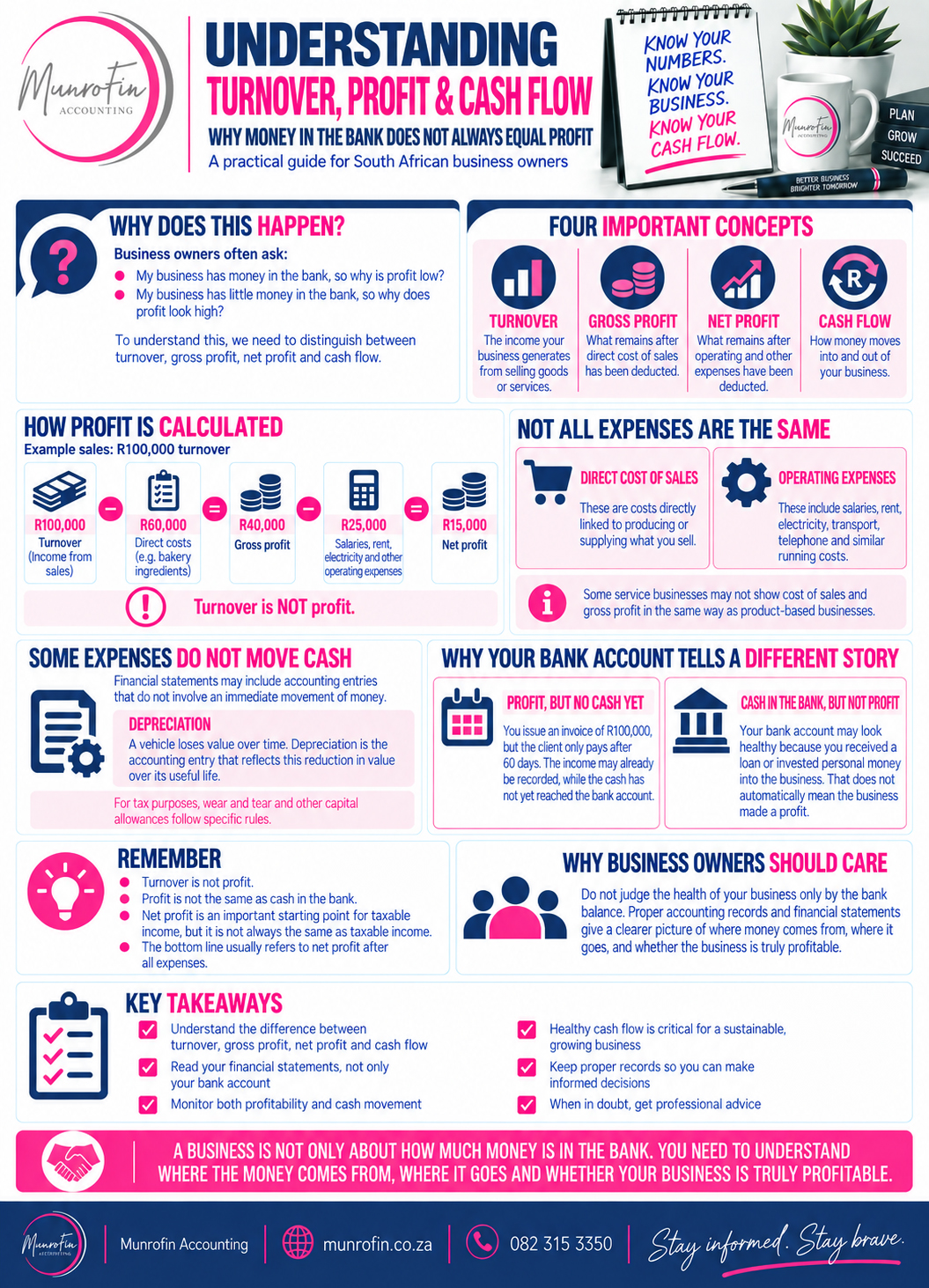
To understand this, we first need to distinguish between the following important concepts, which are often confused with one another:
Turnover, gross profit, net profit and cash flow.
Let us begin with turnover.
Turnover is essentially the income your business generates from selling goods or services.
However, turnover does not mean that all of that money is profit.
For example, let us say your business makes sales of R100,000. That R100,000 is not profit, because you still have expenses that need to be paid.
Suppose you run a bakery. You need to purchase ingredients to fulfil your bread orders.
These direct costs are then deducted from your R100,000. The amount remaining determines your gross profit, sometimes referred to as “GP”.
After that, other operating expenses such as salaries, rent, electricity and so on are deducted to calculate your net profit.
Net profit is what remains after the business’s other operating expenses have also been deducted.
Some of the expenses shown in the financial statements may only be accounting entries and may not necessarily involve the direct movement of money.
A good example of this is depreciation on assets such as vehicles.
We all know that when you buy a brand-new vehicle today, it already loses value the moment you drive it out of the dealership.
As time passes and you drive more and more kilometres, the vehicle continues to lose value until it eventually needs to be replaced.
Depreciation is the accounting entry that reflects the reduction in the value of the vehicle over its useful life in the financial statements.
For tax purposes, however, there are specific rules that determine whether and how depreciation, wear and tear or other capital allowances may be claimed.
Now we come to the next concept: cash flow.
For example, you may issue an invoice of R100,000 to a client, but if the client only pays you after 60 days, you may already have recorded the income in your accounting records, while the R100,000 has not yet been received in your bank account.
Your business may therefore show turnover and, hopefully after expenses, a profit, while your bank account tells a different story.
The opposite can also happen.
You may have money in your bank account because, for example, you received a loan or invested money into the business.
This does not necessarily mean that your business made a profit.
Put very simply:
Turnover is not profit, and profit is not the same as cash in the bank.
This is why it is important for a business owner not to look only at the bank account and assume that the business is doing well.
Proper accounting records and financial statements can give you a much clearer picture of how your business is really performing.
In our next talk, we will look at something closely related to this, namely why it is so important to keep your business money and personal money separate.
Remember: a business is not only about how much money is in the bank.
You need to understand where the money comes from, where it goes and whether your business is truly profitable.
To summarise:
Turnover is the income your business generates from selling goods or services.
Gross profit is what remains after the direct cost of sales has been deducted.
Remember, however, that not all businesses necessarily have a direct cost of sales.
A service-based business, such as a consulting business, may not show cost of sales and gross profit in its financial statements, but may instead mainly have operating expenses such as telephone costs, transport, salaries and so on.
Net profit is what remains after all operating and other expenses have been deducted, regardless of whether those expenses involved an actual movement of money or were only accounting entries.
Net profit is an important starting point when taxable income is determined for income tax purposes.
However, net profit and taxable income are not necessarily the same amount.
You may also have heard the term “bottom line”.
This refers to the net profit after all expenses have been deducted.
Cash flow tells its own story and shows how money moves into and out of your business.
Healthy cash flow that is properly managed is critically important for a sustainable and growing business.
There you have it.
May you have a week of increasing turnover, good profits and positive cash flow.
Until next week.
Goodbye.
Need assistance with your tax or accounting matters?
Contact MunroFin for professional tax, accounting and financial services.