Understanding Business Structures
Moet ek my besigheid registreer?
Last reviewed: 09/09/2026
Luister na die Afrikaanse Radio Uitsending
English Transcript of Radio Broadcast
GOOD DAY
This is Maryna speaking. I am a member of the South African Institute of Professional Accountants and a registered tax practitioner.
In our discussions so far, we have focused mainly on personal tax, but over the next few weeks, I will be speaking more to those who run a business.
Please remember that these talks are not exhaustive or comprehensive. The aim is to inform the general public about basic business and tax aspects.
Let’s start with a few very basic principles.
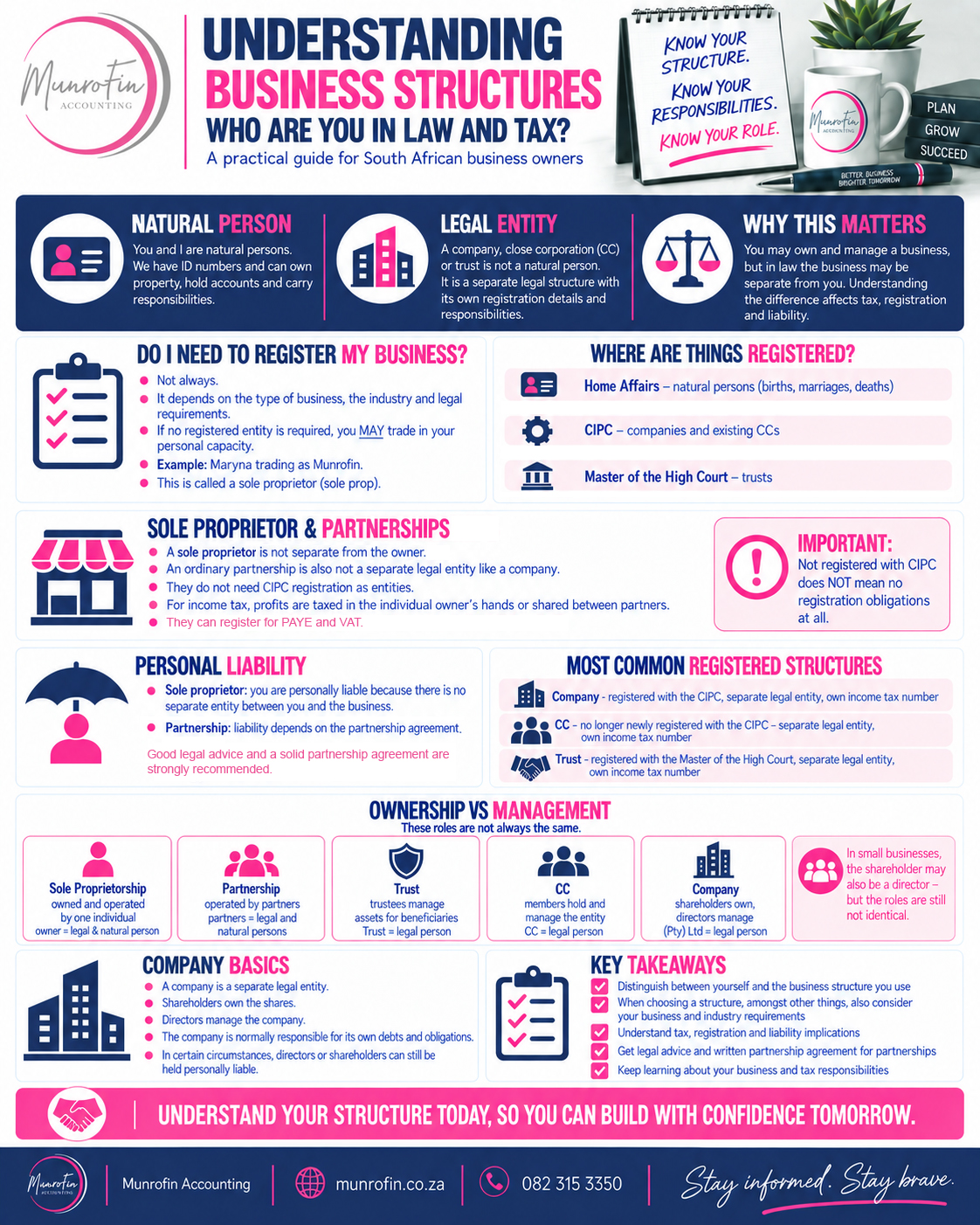
You and I can have a coffee; we can listen and chat—we are natural persons, and as well as legal entities.
In the business world, we encounter various business structures; the most common are companies, close corporations, and trusts—these are not natural persons, but they are legal entities.
Just as you and I, as natural persons, have ID numbers, registered entities like companies and close corporations have registration numbers.
And just as you and I can own property, hold accounts, and bear responsibility for certain obligations, a separate legal entity can also own property, enter into contracts, and be responsible for its own obligations.
It is very important to distinguish between you as an individual and the business you operate.
You might be the sole owner and manager of your business, but if your business is a company, for example, you and the company are two separate entities in the eyes of the law.
In South Africa, Home Affairs handles the registration of births, marriages, and deaths of natural persons, while the CIPC handles the registration of entities such as companies and close corporations (CCs).
Trusts, on the other hand, are registered with the Master of the High Court.
Over the years, I have often been asked the question:
“Do I need to register my business?”
The answer is: not necessarily.
It depends on the type of business, the industry in which you intend to operate, and the specific requirements of that industry.
For instance, if you wish to start a business and there is no requirement to have a company or other registered entity, you can trade in your personal capacity.
For example: Maryna, trading as Munrofin.
In such a case, there is no separate legal entity distinct from me as a natural person—my business and I are one and the same.
This type of business is commonly known as a sole proprietorship, or simply a ‘sole prop’
If you and a few other people are running a business together, it could be a partnership.
The key point is that an ordinary sole proprietorship or partnership is not a separate legal entity like a company.
Therefore, a sole proprietorship or ordinary partnership does not need to be registered with the CIPC.
Furthermore, for income tax purposes, the business is not treated as a separate taxpayer distinct from the individual or partners; business profits are factored into the individual’s personal tax or allocated to the partners according to their profit-sharing arrangement.
However, this does not mean that such a business is exempt from registering with any authority or for additional taxes.
For instance, a sole proprietorship or partnership can act as an employer and thus register for employees’ tax (PAYE), as well as for COIDA and other applicable requirements.
Such a business may also register for VAT, provided it meets the necessary criteria.
Depending on the type of business, registration with the local municipality might also be required.
It all depends on the specific business.
However, one major difference between a sole proprietorship or partnership and a company is the issue of personal liability.
In a sole proprietorship, there is no separate legal entity standing between you and the business; consequently, you bear personal liability.
In the case of an ordinary partnership, it is crucial to fully understand the implications of your specific partnership agreement and the relevant legislation. I would strongly recommend that anyone considering a partnership obtain proper legal advice and have a sound partnership agreement drawn up.
Once the honeymoon phase of a new partnership is over, a pre-existing partnership agreement can prove invaluable.
Let us now briefly look at the most common registered business structures: companies, CCs, and trusts. While other structures exist, I will focus only on these today.
A company is registered with the CIPC and also has its own income tax number with SARS.
A CC, or close corporation, can no longer be newly registered, though many CCs registered years ago still exist. A CC is also a separate legal entity with its own registration number with the CIPC and income tax number with SARS.
A trust is registered with the Master of the High Court and must also be registered with SARS for income tax, even if the trust is inactive
Let’s briefly discuss the key roles regarding ownership and management.
A sole proprietorship is owned and operated by an individual; therefore, there is no separate legal entity.
A partnership is operated by the partners, and legal liability must be carefully determined—among other things—by the partnership agreement and applicable legislation.
In the case of a trust, trust assets are managed by trustees in accordance with the trust deed, for the benefit of the beneficiaries. Consequently, a trust is not owned in the same way as a company. Trustees may receive remuneration for their services if the trust deed permits it.
A Close Corporation (CC) is held and managed by its members and exists as a legal entity separate from its members.
A company is owned by shareholders and managed by directors; it is a separate legal entity.
It is particularly important to understand the distinction between ownership and management in the context of a company.
Shareholders own the shares in the company, whereas directors manage the company. In smaller businesses, the shareholder is often also a director, but this does not mean the two roles are identical.
This concept is easier to grasp if you consider a large company like Pick n Pay or Standard Bank.
The directors manage the company, but they are not necessarily its owners. The shareholders are the owners by virtue of their shareholding.
Note: shareholders have the right, among other things, to appoint directors and—under certain circumstances—to remove them. Once again, a company is a separate legal entity and is therefore normally responsible for its own debts and obligations. However, a director or shareholder can be held personally liable in specific circumstances.
Well, I hope this talk has clarified things a bit regarding the various business structures.
If you own a business, be sure to look out for my weekly talks, as we will be discussing businesses and their tax responsibilities in more detail over the coming weeks.
Stay informed and stay brave—entrepreneurship isn’t always easy, but our country needs you, and you are certainly making a big difference!
Have a blessed week ahead!
Need assistance with your tax or accounting matters?
Contact MunroFin for professional tax, accounting and financial services.