Business Expenses: What Can Your Business Really Claim?
Besigheidsuitgawes: Wat Kan Jou Besigheid Werklik Eis?
Last reviewed: 30/09/2026
Luister na die Afrikaanse Radio Uitsending
English Transcript of Radio Broadcast
This is Maryna, and we are continuing with our business talks, especially for the entrepreneur listener.
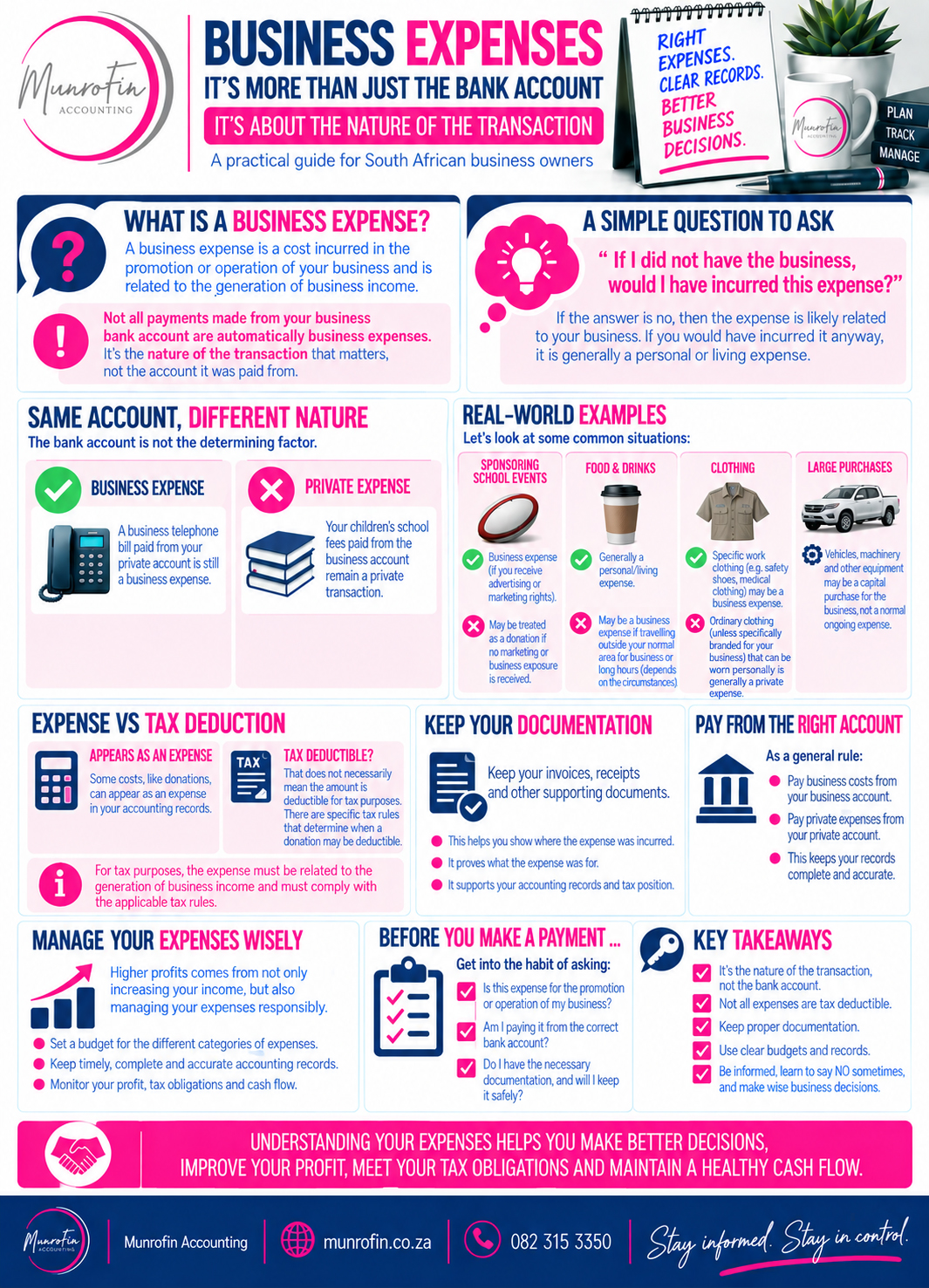
What is a business expense? It sounds so simple, doesn’t it? And are all payments made from my business bank account considered business expenses?
Remember that last week I said that the bank account from which the payment is made is not necessarily the determining factor when deciding whether something is a business expense or not.
I gave the example of your children’s school fees being paid from the business account. It remains a private transaction, while the business’s telephone bill, which you happened to pay from your private account, is still a business expense.
We should really try to pay all business costs from the business account and private expenses from the private account. This helps us keep our accounting records complete and accurate.
Today’s topic is therefore really about the nature of the transaction. In other words, is it a business transaction or a private transaction, regardless of which account the payment is made from?
A very simple, although not always complete, way of thinking about this is to ask yourself:
If I did not have the business, would I have incurred this expense?
For example, would I have taken these people out for lunch this afternoon if I did not have the business?
If my answer is no, if I would not have done it, then it means that I incurred the expense because I have the business. In other words, the transaction relates to the business.
Because my talks are aimed at smaller businesses, I like using examples that we regularly see in smaller businesses.
One such example is when entrepreneurs sponsor school events, for example, a sporting event.
If your business sponsors such an event and, in return, you receive the right to promote your business, then you are receiving something in return for your money.
This could be advertising or marketing rights, and the cost can then be treated as a marketing or advertising expense, subject to the normal tax requirements.
If, however, your business simply gives money to the school and your business name is not displayed anywhere as part of the marketing or advertising arrangements, then it may instead have the nature of a donation.
And here we need to distinguish between what appears as an expense in your income statement and what is ultimately deductible for tax purposes.
A donation can therefore appear as an expense in your accounting records, but that does not necessarily mean that it is deductible for tax purposes.
There are specific tax rules that determine when a donation may be deductible.
The most important principle to remember is that, for tax purposes, the expense must be related to the production of business income and must comply with the applicable tax rules.
Let’s use another simple example.
You have been driving around the business area or town during the day, as you do most days, and you stop at a shop to buy yourself a cooldrink and a pie.
Is that a business expense?
Let’s use my basic question from above.
If I did not have the business, would I still have incurred the expense?
Well, you would most likely have eaten and drunk something anyway.
This type of expense is therefore generally a personal living expense and not simply a business expense because you bought it during your working day.
However, if you had to travel to a neighbouring town or city for business purposes, or you had to work an unusually long shift and needed to purchase additional food that you would normally have eaten at home, the tax treatment may be different, depending on the circumstances.
Another common example is clothing.
If you had to purchase specific clothing or shoes for your particular occupation, for example, steel-toe safety shoes or medical clothing, there is a clear connection to your business and it may therefore be considered a business expense.
But suppose your business has something to do with agriculture and you simply like wearing khaki clothing.
Anything that you can purchase from an ordinary clothing store and that can also be worn for personal use would generally be regarded as a personal or living expense that you incur, and it would not necessarily be deductible for tax purposes.
If, however, you had the same clothing branded with your business name or logo, and it was specifically used to promote your business while you were out and about, the situation could be different.
A large purchase, such as a vehicle, machine or other equipment, may instead be a capital purchase for the business. However, it is not necessarily treated in the same way as an ordinary ongoing business expense.
It is therefore important to ask:
Why did my business pay for this, and is it related to the production of income for my business?
It is also important to keep your invoices, quotations and other documentation. This helps you demonstrate where the expense was incurred and what it was incurred for.
And finally, we improve our business performance not only by increasing our income, but also by managing our expenses responsibly.
A budget for the different categories of expenses, together with timely, complete and accurate accounting records, helps us to better monitor our profit, tax obligations and cash flow.
So, before you make your next payment, get into the habit of asking:
Is this expense for the promotion or operation of my business?
Am I paying it from the correct bank account?
And do I have the necessary documentation for the payment, and will I keep it safely?
Be informed, learn to say no sometimes, and make wise business decisions.
Have a blessed week. Goodbye!
Need assistance with your tax or accounting matters?
Contact MunroFin for professional tax, accounting and financial services.