Understanding Personal & Business Bank Accounts
Die skeiding van persoonlike en besigheids bank rekeninge
Last reviewed: 23/09/2026
Luister na die Afrikaanse Radio Uitsending
English Transcript of Radio Broadcast
Good day.
This is Maryna, and we are continuing with our business discussions. I would like to talk to you about separating personal and business bank accounts.
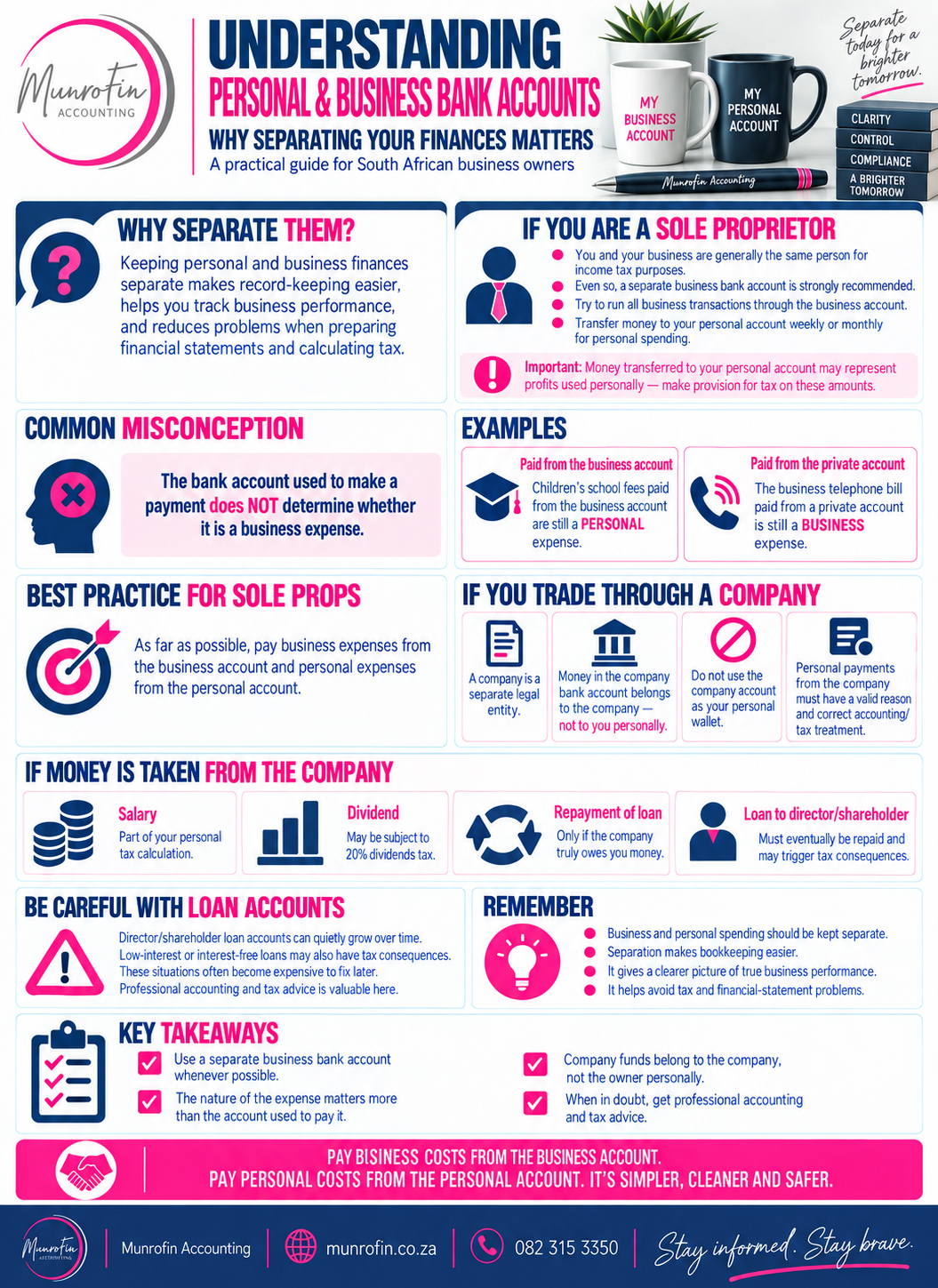
If you trade as a sole proprietor, you and your business are essentially the same person for income tax purposes. However, I still recommend having separate bank accounts for your business and your personal finances. This simplifies your record-keeping and allows you to more easily track your business’s performance. Ensure that all business transactions take place within the business account, and—preferably on a monthly or weekly basis—transfer an amount to your personal account to cover your personal expenses from there.
Remember that these transfers to your personal account essentially represent the profits of your sole proprietorship that you are using personally; you must still make provision for tax on these amounts.
There is also a common misconception that the bank account used to make a payment determines whether or not a transaction is a business transaction. This is not the case.
For example, if you pay your children’s school fees from your business account, it does not become a business expense simply because it was paid from that account—it remains a personal expense.
Conversely, if you pay the business’s telephone bill from your private account, it remains a business expense, even though it was paid from a private account.
So, even for a sole proprietorship, try to maintain a separate bank account for your business and, as far as possible, settle all business transactions from that account, while paying for personal transactions from your personal bank account.
If you trade through a company, the situation is different, and I would like you to pay close attention now to try and understand this properly.
A company is a separate legal entity. Consequently, the funds in the company’s bank account belong to the company, not personally to the director or shareholder—even if you are the sole director and/or shareholder.
Please do not treat the company’s money as your own personal funds. You cannot simply use the company’s bank account as your personal wallet.
If you withdraw money from the company for personal expenses—whether by paying yourself directly or having the company make payments on your behalf—there must be a valid reason and the correct accounting and tax treatment applied.
For example: Is it a salary, a dividend, a repayment of funds you previously lent to the company, or a loan granted to you by the company?
If you previously provided or lent money to the company, then the company owes you money, right?
Such transfers or personal payments can therefore be viewed as a repayment of that loan, provided the company indeed still owes you that amount.
However, if the company does not owe you money, such payments cannot be the repayment of a loan; instead, the transactions would constitute either a salary, a dividend, or a loan granted to you that must eventually be repaid to the company.
If classified as a salary, it forms part of your personal tax calculation—meaning you will be personally liable for tax on that amount.
If it is a dividend, it is subject to a 20% dividends tax, after taking into account the relevant company and dividend regulations.
If it is a loan granted to you as a director and/or shareholder, it can become a quietly growing problem that catches many people off guard. We often hear people say, “I’ll sort it out later.” But “later” keeps getting pushed back, more similar transactions occur, and before you know it, you are left with a substantial loan account that must be repaid to the company.
This can lead to tax consequences you may not have anticipated at all.
Tax legislation can have specific implications for loans or financial benefits granted by a company to a shareholder or director; low-interest or interest-free loans can also trigger tax consequences. These quietly accumulating loan accounts frequently cause sleepless nights, as rectifying the situation will cost you money—whether through repaying the company or paying the resulting taxes. Therefore, be very cautious regarding such a loan account; the insight of an expert in the fields of accounting and taxation can be extremely valuable here.
Next week, I’ll discuss in more detail which types of transactions qualify as valid business expenses.
But for today, the most important message is this:
As far as possible, try to pay for all business transactions from your business bank account and personal transactions from your personal bank account.
This makes record-keeping easier, helps you better understand your business’s actual performance, and can prevent many problems when preparing financial statements and calculating taxes.
We’ll talk more next week.
Have a blessed week!
Need assistance with your tax or accounting matters?
Contact MunroFin for professional tax, accounting and financial services.