Employee or Independent Contractor? Understanding the Difference
Werknemer of Onafhanklike Kontrakteur? Verstaan die Verskil
Last reviewed: 28/10/2026
Luister na die Afrikaanse Radio Uitsending
English Transcript of Radio Broadcast
Good day!
Maryna here. Today, we continue our discussion with entrepreneurs regarding the question: When is someone truly an independent contractor, and when are they actually an employee?
An employee places their working capacity and time at the disposal of an employer. If the employer wants the employee to simply “keep the seat warm” for the day, then that is what happens! On other days, the employee might be expected to work at a frantic pace.
An independent contractor, by contrast, undertakes to deliver a specific service, result, or product—and, in principle, determines for themselves how to achieve it.
However, in practice, the distinction is not always that straightforward.
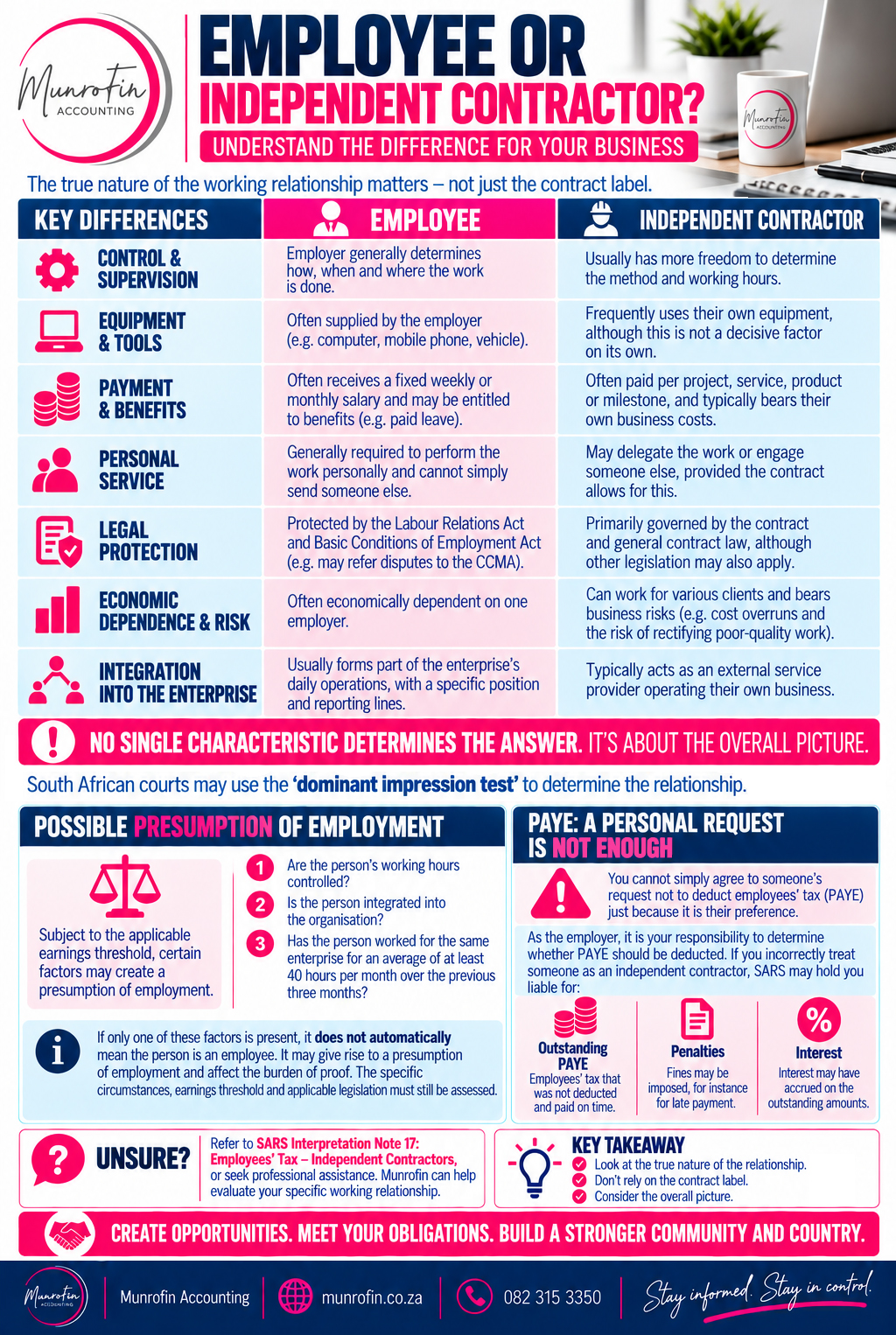
In South Africa, the focus is on the true nature of the working relationship, rather than merely the label given to the contract. The courts use, among other methods, the so-called “dominant impression test” to determine whether someone is genuinely an employee or an independent contractor.
Let’s look at a few characteristics that can help clarify the difference.
Firstly: Control and supervision.
An employer generally determines, to a greater extent, how, when, and where an employee must perform their work. An independent contractor usually has more freedom to determine the method and working hours themselves.
Secondly: Equipment and tools.
An employer often provides the employee’s computer, mobile phone, vehicle, or other work equipment. An independent contractor frequently uses their own equipment. However, this is not a decisive factor on its own.
Thirdly: Payment and benefits.
An employee often receives a fixed weekly or monthly salary and may be entitled to benefits such as paid leave and other employment perks.
An independent contractor is often paid based on a project, service, product, or agreed-upon milestones, and typically bears the costs of their own business operations.
Fourthly: Personal service.
An employee is generally required to perform the work personally and cannot simply send someone else in their place; whereas an independent contractor may sometimes delegate the work or engage someone else to assist, provided the contract allows for this.
Fifthly: Legal protection.
Employees enjoy protection under legislation such as the Labour Relations Act and the Basic Conditions of Employment Act. For instance, they may refer a dispute regarding unfair dismissal to the CCMA. An independent contractor’s relationship is primarily governed by the contract and general contract law, although other legislation may also apply.
Sixthly: Economic dependence and risk.
An employee is often economically dependent on a single employer. An independent contractor can work for various clients and typically bears certain business risks themselves, such as cost overruns and the risk of having to rectify poor-quality work.
Lastly: Integration into the enterprise.
An employee usually forms part of the enterprise’s daily operations, holding a specific position with defined reporting lines and responsibilities, whereas an independent contractor typically acts as an external service provider operating their own business.
However, bear in mind: No single characteristic necessarily determines the answer. It is about the overall picture of the relationship.
There are also specific legal provisions that may play a role. For instance, under the Labour Relations Act and the Basic Conditions of Employment Act, a person—subject to the applicable earnings threshold—may be presumed to be an employee if certain factors are present.
These factors include, among others, whether the person’s working hours are controlled, whether the person forms part of the organization, or whether the person has worked for the same enterprise for an average of at least 40 hours per month over the preceding three months.
If only one of these factors is present, does that automatically mean the person is an employee?
No, not necessarily. It may, however, give rise to a presumption of employment and affect the burden of proof. The specific circumstances must still be assessed. The earnings threshold and the applicable legislation are also important.
So, where does the problem arise for you as an entrepreneur?
You might think: “Oh, paying tax is always such a hassle! The person working for me actually asked that I not deduct employees’ tax from their pay each month—they’d prefer to handle the tax themselves.”
Are you allowed to agree to this?
The answer is: not simply because that is the person’s preference.
As the employer, it is your responsibility to determine whether employees’ tax—known as PAYE—should be deducted. You must consider the true nature of the working relationship and the relevant tax regulations.
If you incorrectly treat someone as an independent contractor, and SARS later determines that employees’ tax should have been deducted, you could be held liable for:
Outstanding PAYE: The employees’ tax that was not deducted and paid over on time.Penalties: Fines may be imposed, for instance, for late payment.Interest: Interest may have accrued on the outstanding amounts.
While the ultimate liability depends on the specific circumstances and applicable legislation, the costs can certainly be significant.
If you are unsure about someone’s status, you can consult SARS’s official Interpretation Note 17: Employees’ Tax – Independent Contractors, or seek professional assistance to evaluate the specific working relationship. Munrofin would be happy to help with this.
There you have it! Take a close look at the nature of your working relationships. It is a privilege to be able to offer job opportunities and, in doing so, contribute to the lives of others and to the economy. Let us fulfill our obligations and work together to build a better community and country.
Until next week!
Need assistance with your tax or accounting matters?
Contact MunroFin for professional tax, accounting and financial services.