Business Documents: What Records Must Your Business Keep?
Watter Dokumente Moet Jy Vir Jou Besigheid Bewaar?
Last reviewed: 07/10/2026
Luister na die Afrikaanse Radio Uitsending
English Transcript of Radio Broadcast
Good day, it’s Maryna here.
I am a member of the South African Institute of Professional Accountants and a registered tax practitioner.
We are continuing with our business chats, especially for the entrepreneur listener, and today our topic is about what paperwork and documentation I need to keep for my business.
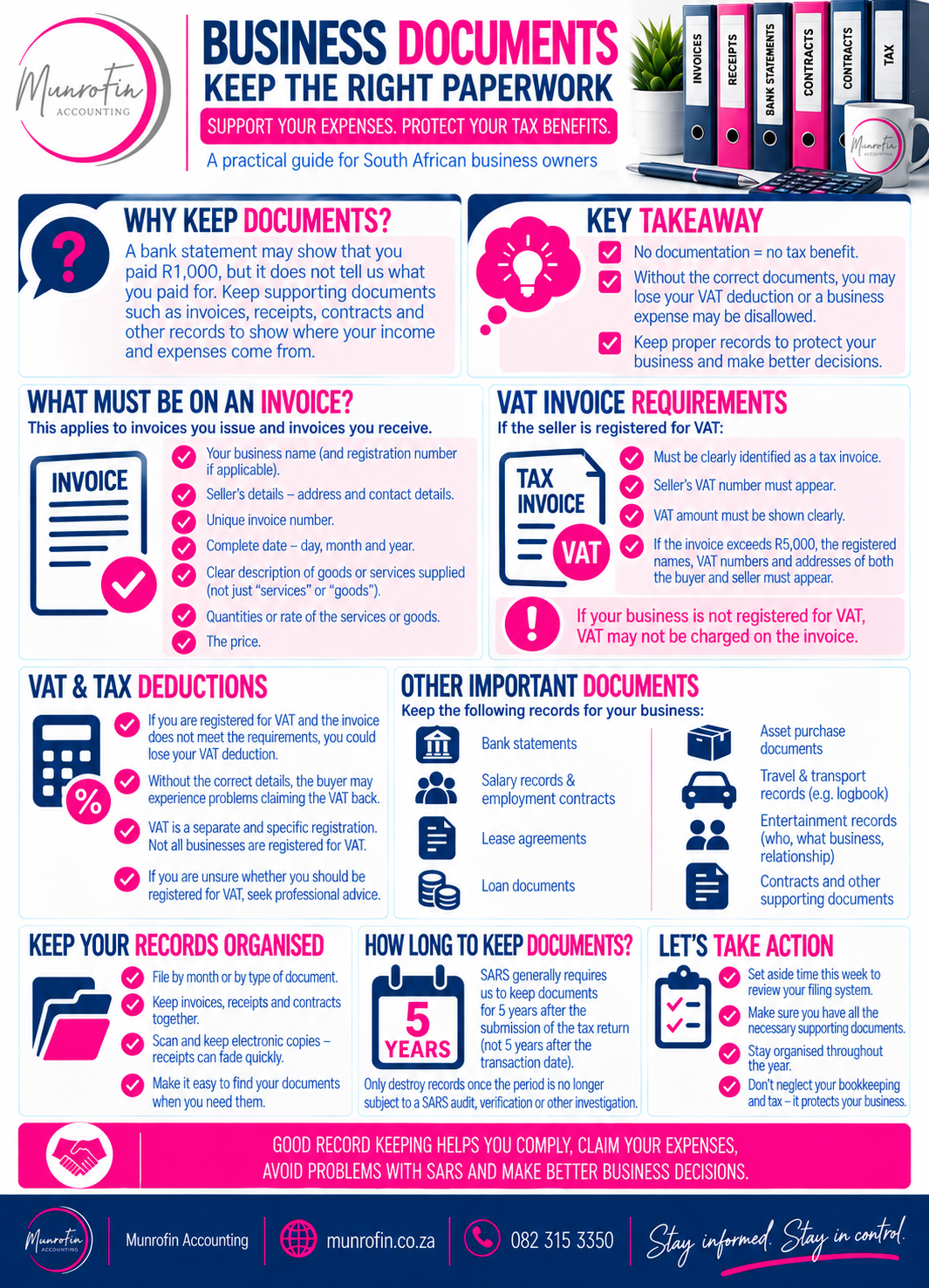
A bank statement may show that you paid R1,000. It tells us that you paid R1,000, but it doesn’t necessarily tell us what you paid for. You should therefore have documentation showing where your income and expenses come from, for example invoices, receipts – especially for cash transactions – contracts or other documents supporting your sales or services.
The requirements for the details on invoices differ depending on whether or not you are registered for VAT.
Let’s talk a little more in depth about invoices, and please keep this in mind for invoices that your business issues, as well as invoices that you receive when you incur and pay expenses.
The invoice must show the business name. If you trade as a company, it must contain the company’s registered name and registration number.
If you trade as a sole proprietor or partnership, the invoice will not necessarily have a registration number.
The invoice must show the seller’s details, such as the address and contact details. It must have a unique invoice number, as well as a complete date – in other words, the day, month and year.
The invoice must also describe what type of services or goods were supplied or sold. It cannot simply state “services” or “goods”. Where applicable, the quantities or rate of the services or goods must be indicated, as well as, of course, the price.
If the seller is registered for VAT, the invoice must be identified as a tax invoice. The seller’s VAT number must appear on it.
The invoice must also indicate, very clearly, how much VAT was charged.
Please remember: if the business is not registered for VAT, VAT may not be charged on the invoice.
When the value of the tax invoice exceeds the applicable threshold, which is currently R5,000, there are additional VAT requirements. Among other things, the registered names, VAT numbers and addresses of both the buyer and seller must appear on the invoice.
Without these details, the buyer may experience problems claiming the VAT back because the invoice does not comply with the VAT requirements.
The above sounds very simple. Yet we regularly see invoices that do not comply with the basic requirements.
If you are registered for VAT and the invoice does not meet the necessary requirements, you could lose your VAT deduction.
For the business owner listening to this who is not sure whether he or she is registered for VAT or should register for VAT: I will be discussing the subject of VAT in more detail soon.
VAT is an additional tax, and you are not necessarily registered for it. An entrepreneur should therefore know whether he or she is specifically registered for VAT, because it is a separate and very specific registration.
Other documents that business owners should keep include bank statements, salary records and employment contracts, lease agreements, loan documents, and documents relating to assets purchased by the business.
If you travel or use transport for business purposes, it is also important to keep the necessary records, such as accurate entries in a logbook where applicable.
For entertainment expenses, I recommend that you keep a record of who you entertained, which business he or she represents, and what the relationship is with your business – for example, an associate, supplier, potential client or existing client.
I would also suggest that you keep your documents organised throughout the year, preferably by month or by type of document, so that you can easily find them when you need them.
Many of the receipts we receive fade very quickly and are no longer readable later. Rather scan them and keep electronic copies of them.
SARS generally requires us to keep documents for five years after the submission of the tax return.
Please note: not five years after the transaction date, but five years after the submission of the tax return.
It is also advisable to make sure that the specific period is no longer subject to a SARS audit, verification or other investigation before the records are destroyed.
I’m not particularly fond of paperwork myself, but let’s commit to setting aside a little time during the next week to look at our filing system and how we store our documents.
We certainly don’t want to lose the tax benefit of an expense simply because we no longer have the supporting documentation.
Bookkeeping and tax require organisation, and that is why I want to encourage you not to neglect it.
Have a blessed week. Goodbye!
Need assistance with your tax or accounting matters?
Contact MunroFin for professional tax, accounting and financial services.