Forming a Company
Stigting van 'n Maatskappy
Last reviewed: 04/11/2026
Luister na die Afrikaanse Radio Uitsending
English Transcript of Radio Broadcast
Good day!
This is Maryna. I am a member of the South African Institute of Professional Accountants and a registered tax practitioner with SARS.
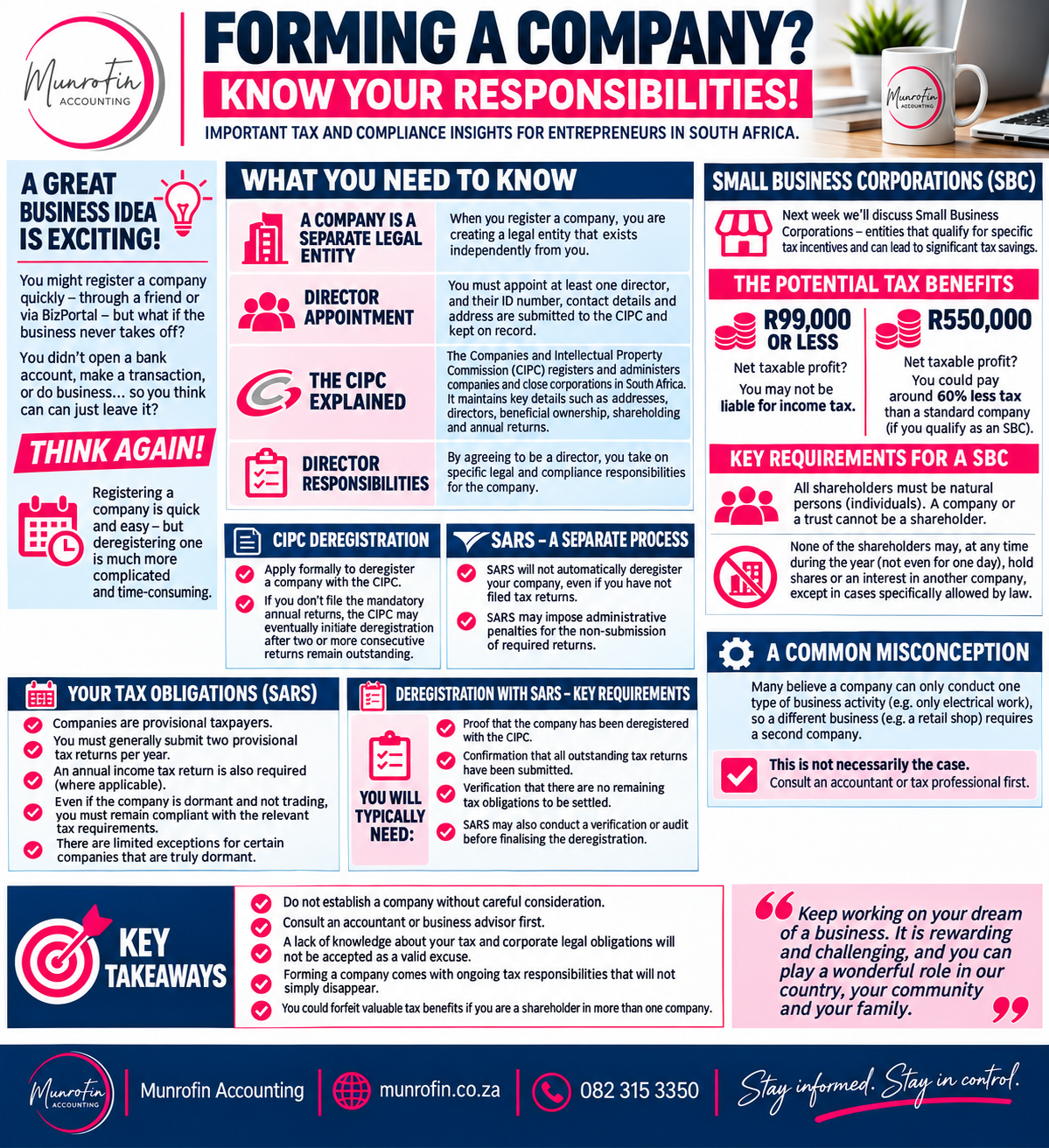
Have you ever had a business idea and quickly registered a company—perhaps through a friend, or even by yourself via the BizPortal website—only for the business to never get off the ground? You didn’t even get as far as opening a bank account or conducting your first transaction. And because you assumed nothing had really happened, you figured you could just leave it be.
Think again! Today, I want to tell you that establishing—or registering—a company is much easier and faster than deregistering one.
It is important to remember that a company is a separate legal entity. In other words, when you establish a company, you are bringing a legal entity into existence. To do this, you must appoint at least one person as a director. The director’s information—such as their ID number, contact details, and address—is submitted to the CIPC and kept on record.
Just a quick reminder: what is the CIPC? It stands for the Companies and Intellectual Property Commission. This is the authority responsible for the registration and administration of companies and close corporations in South Africa, maintaining all key details such as addresses, directors, beneficial ownership, shareholding, and annual returns.
By agreeing to serve as a director of a company, you take on specific responsibilities.
When a company is registered with the CIPC, it is typically also automatically registered for income tax with SARS. While this happens automatically, surprisingly, the deregistration process with the CIPC is not automatically reflected at SARS.
To deregister a company with the CIPC, it is best to submit a formal application for deregistration. However, many people simply fail to file the mandatory annual returns with the CIPC. Over time—specifically once two or more consecutive annual returns remain outstanding—the CIPC may initiate the company’s deregistration process.
Please be careful not to assume that the same applies to SARS; this is certainly not the case. SARS will not automatically deregister your company simply because you have failed to file tax returns. On the contrary, SARS may impose administrative penalties for the non-submission of the required returns.
Companies are also classified as provisional taxpayers and are generally required to submit two provisional tax returns per year, in addition to an annual income tax return where applicable. Even if a company is dormant and not conducting any business, you must ensure that you remain compliant with the relevant tax requirements. There are, however, limited exceptions regarding the annual income tax return for certain companies that are truly dormant.
Therefore, even if your company has already been deregistered with the CIPC, you must still complete a separate deregistration process with SARS.
Requirements for deregistration with SARS include, among other things: proof that the company has been deregistered with the CIPC, confirmation that all outstanding tax returns have been submitted, and verification that there are no remaining tax obligations to be settled. SARS may also conduct a verification or audit before the deregistration process is finalized.
While we encourage entrepreneurship, I would like to offer a friendly reminder: do not simply establish a company without careful consideration.
Furthermore, you should certainly not proceed without at least one consultation with an accountant or business advisor. A lack of knowledge regarding your tax and corporate legal obligations will not be accepted as a valid excuse.
Next week, I will discuss “Small Business Corporations”—entities that qualify for specific tax incentives and can benefit from significant tax savings.
For example, if your business has a net taxable profit of R99,000 or less, it may not be liable for any income tax. Alternatively, with a net taxable profit of R550,000, it could pay approximately 60% less tax than a standard company, provided it qualifies as a Small Business Corporation.
One of the requirements for this tax benefit is that all shareholders of the company must be natural persons. In other words, another company or a trust cannot act as a shareholder.
Another important requirement is that none of the shareholders may, at any point during the year—not even for a single day—hold shares or an interest in another company, except in cases specifically provided for by law.
We often encounter a common misconception that a company may only conduct one type of business activity—for example, solely electrical work. Consequently, one might assume that starting a different type of business, such as a retail shop, requires the formation of a second company.
This is not necessarily the case. I would recommend consulting an accountant or a tax professional about this first.
Please remember that the purpose of these discussions is to better inform the general public—particularly those who are less experienced in business.
Today, I hope you understand that when you form a company and serve as a director, you assume certain responsibilities. You need to be aware of what those responsibilities are and what their implications might be.
Therefore, exercise good judgment when forming a company. Be aware that doing so entails tax responsibilities that will not simply disappear, and that you could potentially forfeit a tax benefit if you are a shareholder in more than one company.
Keep working on your dream of a business. It is rewarding and challenging, and you can play a wonderful role in our country, your community, and your family.
Until next week!
Need assistance with your tax or accounting matters?
Contact MunroFin for professional tax, accounting and financial services.