Travel Allowance and Tax
Reistoelae en belasting – Wat jy moet weet
Last reviewed: 26/08/2026
Luister na die Afrikaanse Radio Uitsending
English Transcript of Radio Broadcast
GOOD DAY
This is Maryna, and today I want to talk to you about travel allowances.
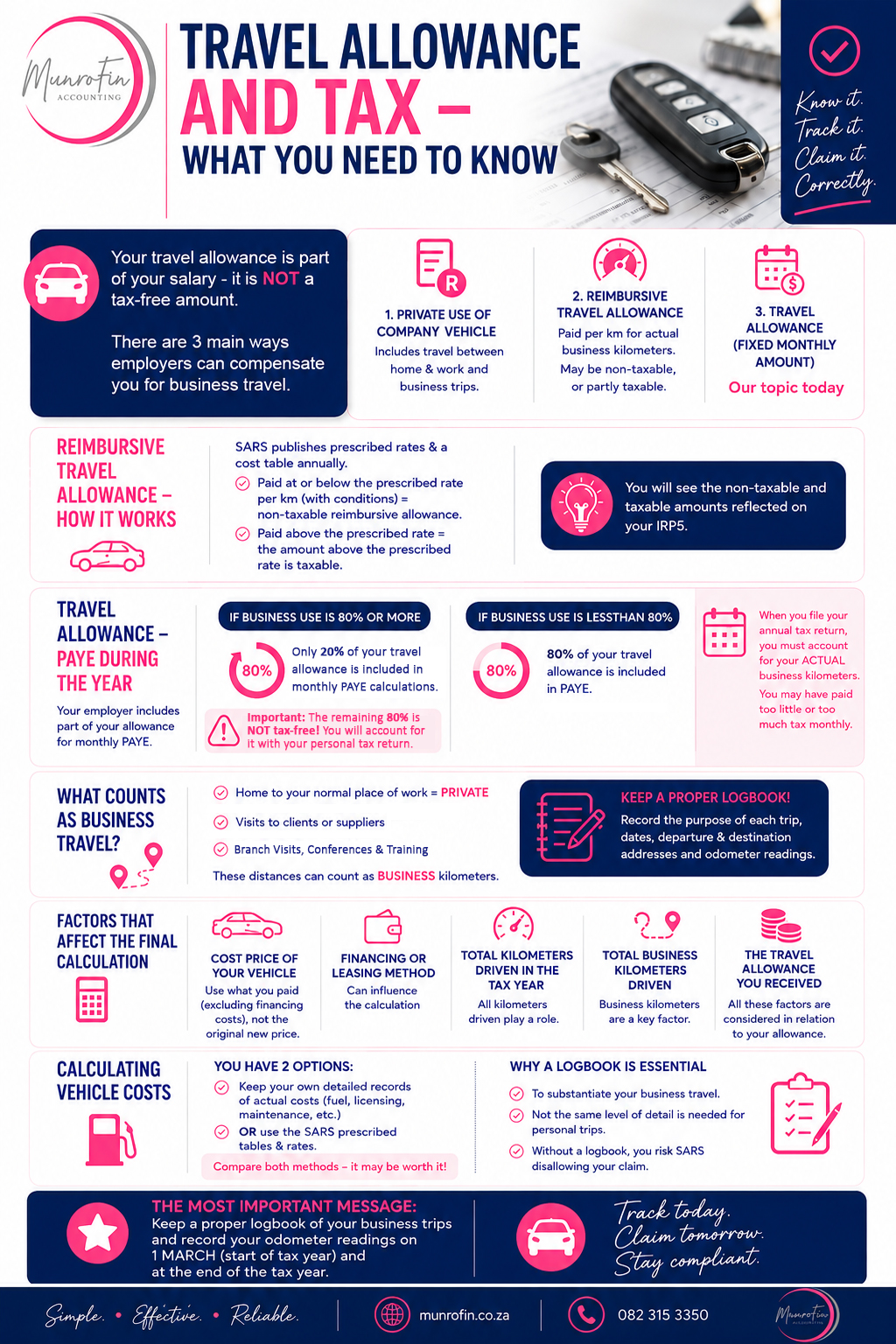
There are various ways an employer can compensate you for driving for business purposes.
One way is, for example, having the use of a company vehicle that you drive between home and work, in addition to making various business trips. This method of compensation is referred to as private use of a motor vehicle. However, that is not the topic for today.
Another method involves using your own vehicle for work-related travel, with your employer compensating you per kilometer for the specific business kilometers driven. The employer applies a set rate per kilometer and pays you based on the actual business kilometers traveled.
This may appear on your IRP5 as a non-taxable reimbursive travel allowance, or in certain cases, partly as a taxable reimbursive travel allowance.
Let me explain:
SARS publishes prescribed rates and a cost table annually that can be used for travel expenses. If your employer compensates you at this prescribed rate per kilometer, the reimbursement can—subject to certain conditions—be treated as a non-taxable reimbursive travel allowance.
However, if your employer compensates you at a higher rate per kilometer, the amount exceeding the prescribed rate may be taxable. You would then see both the non-taxable and taxable portions reflected on your IRP5.
This method is the reimbursive travel allowance, where you are compensated based on the specific business kilometers traveled.
But that is not my topic for today, either.
The final method involves receiving a fixed monthly amount as part of your salary, regardless of how many kilometers you traveled that month. This is known as a travel allowance, and it is the subject of today’s discussion.
This travel allowance forms part of your salary, and PAYE provisions regarding it can be handled in one of two ways during the year.
If your employer is satisfied that you will use your vehicle for business purposes at least 80% of the time, only 20% of your travel allowance needs to be taken into account for monthly PAYE purposes.
But take note—this does not mean the remaining 80% is ultimately tax-free!
The other scenario applies if you already know that you will use your vehicle for business purposes less than 80% of the time over the course of the tax year. In this case, 80% of your travel allowance is taken into account for monthly PAYE purposes.
When filing your annual personal tax return, you must ultimately account for the actual business kilometers driven during the year; consequently, you may find that you paid either too little or too much tax on this allowance on a monthly basis.
The purpose of a travel allowance is, therefore, to provide for business trips undertaken in your own vehicle. The travel allowance itself is not a tax-free amount but forms part of your taxable income.
It is important to understand that the kilometers you travel from your home to your normal place of work are considered private kilometers.
However, suppose you have to travel to another branch two days a week, for example, or regularly visit clients or suppliers, or attend a conference. In that case, those distances can count as business kilometers.
It is crucial that you keep a proper logbook.
Make sure to record your odometer reading on 1 March—at the start of the tax year—and again at the end of the tax year. Throughout the year, keep a complete record of the dates you traveled for business, your departure and destination addresses, and the reason for the trip.
You do not need to maintain the same level of detail for personal trips, but you must certainly be able to properly substantiate your business trips.
Various factors play a role in the final calculation of your travel costs:
These include the cost price of your vehicle—in other words, what you paid for the vehicle, excluding financing costs. For instance, if you bought a second-hand vehicle, the amount used is you paid for the vehicle, not its original price when new.
The way you finance or lease the vehicle can also influence the calculation of the actual vehicle costs. However, I will not go into detail on that today.
The total kilometers driven in the vehicle during the tax year play a role, as do the total business kilometers driven during that period.
And, of course, all of this must be viewed in relation to the travel allowance you received.
Regarding vehicle costs: you can keep your own detailed records of fuel, licensing, maintenance, and other relevant vehicle expenses. Alternatively you can use the prescribed SARS tables.
If you have indeed kept detailed records of your actual vehicle costs, it may be worthwhile to compare the two methods.
If you receive a travel allowance and wish to claim business travel expenses against it, a proper logbook is essential.
I hope this has provided a clearer explanation of your travel allowance.
The most important message I want to leave you with today is this: keep a proper logbook of your business trips and ensure you record your odometer readings at the beginning and end of the tax year.
Untill next week!
Need assistance with your tax or accounting matters?
Contact MunroFin for professional tax, accounting and financial services.