SARS Auto-Assessments: Take Responsibility, Stay in Control
SARS se outomatiese aanslae – Neem verantwoordelikheid, bly in beheer
Last reviewed: 15/07/2026
Luister na die Afrikaanse Radio Uitsending
English Transcript of Radio Broadcast
Good day!
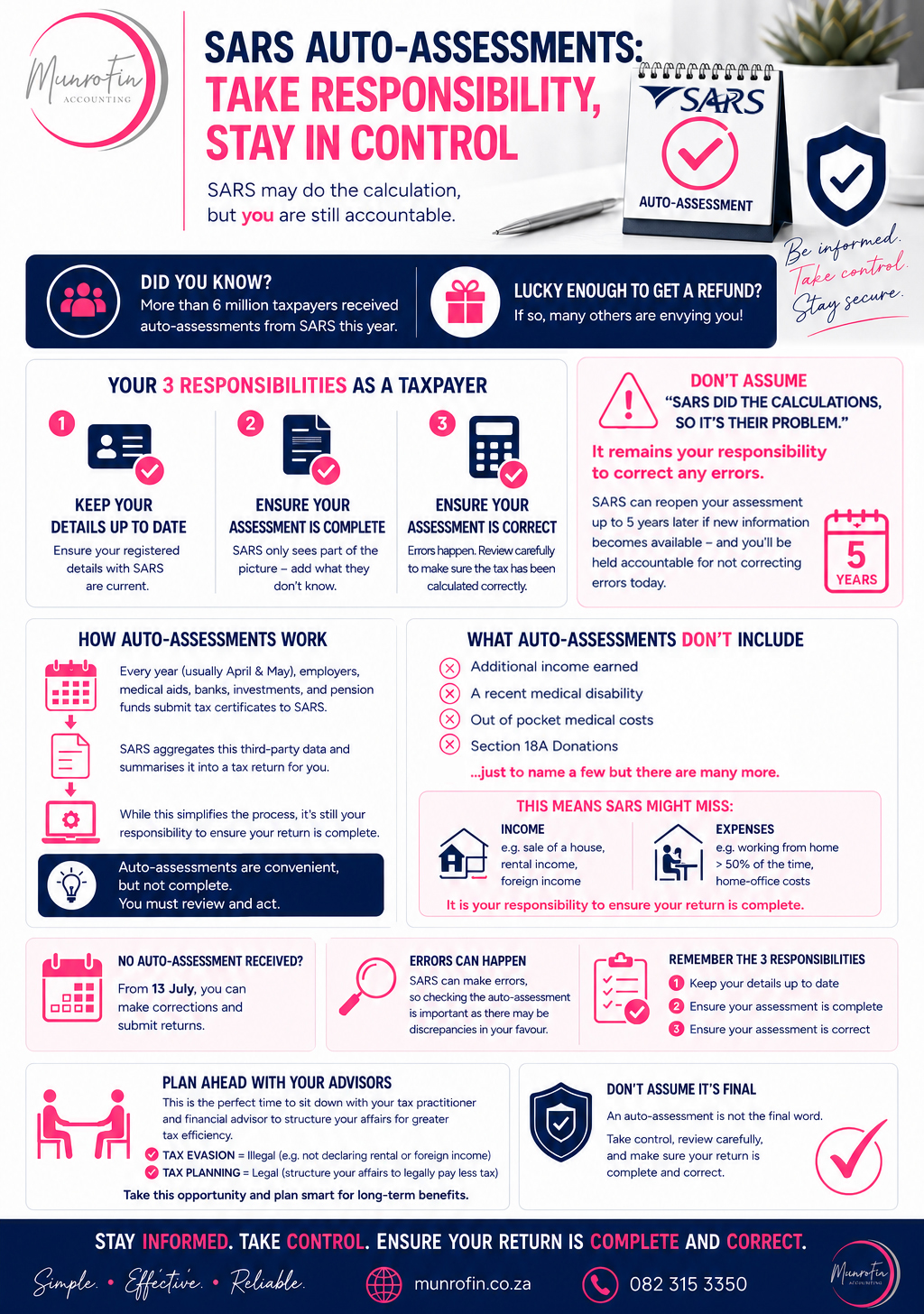
Were you perhaps one of the more than 6 million people who received an auto-assessment from SARS over the past two weeks?
And were you perhaps one of the fortunate taxpayers who received a tax refund from SARS?
While there are certainly many people who welcome this, I think it is a very positive development that SARS is issuing auto-assessments. Every year, more taxpayers are automatically assessed as SARS’s systems and the information available to them become increasingly sophisticated.
However, we must not forget that, as a taxpayer, you still have three responsibilities.
Firstly, you must make sure that your registered details with SARS are up to date.
Secondly, you must make sure that your auto-assessment is complete.
Thirdly, you must make sure that your tax has been calculated correctly.
You must not make the mistake of thinking, “Well, SARS prepared the auto-assessment themselves, so if there is an error, it is their problem.”
Unfortunately, that is not how it works.
Just think about how incredibly much technology has developed over the past five years. Now imagine where we will be another five years from now.
Keep this in mind, together with the fact that SARS can reopen your assessment up to five years later as new information becomes available and hold you accountable for failing to make the necessary corrections.
So, take these responsibilities seriously and do the right thing.
Let me explain where auto-assessments come from and how the process works.
Every year, usually during April and May, employers, medical aid schemes, banks, investment houses, pension funds and retirement funds submit tax certificates to SARS.
These are the certificates SARS receives from third parties. SARS collects and consolidates this information into your tax return.
There are certain requirements that these certificates must meet, but the information SARS receives is what they use to prepare your auto-assessment and make the process easier for you.
However, SARS also tells you that you must ensure that your tax return is complete.
Now, there are certain types of information and transactions that will not be included in your 2026 tax-year auto-assessment.
For example:
- SARS will not know about the garden cottage that you rent out.
- SARS will not know if your child was diagnosed with a disability or special needs during the year.
- SARS will not know if you paid medical expenses out of your own pocket.
- SARS will not know about donations you made to approved public benefit organisations.
And there are many other types of transactions that SARS may not be aware of.
This brings us to the accuracy of the tax calculation.
In other words, SARS may have missed income, for example, proceeds from a property you sold.
Alternatively, SARS may have missed certain expenses. For instance, SARS will not necessarily know that you need to work from home for more than 50% of your working time and therefore qualify for a home office expense deduction.
These are exactly the types of items you need to look out for when reviewing your auto-assessment to determine whether it is complete.
It is your responsibility to make sure that the necessary corrections are made.
From 13 July, we can make corrections and submit tax returns for taxpayers who did not receive an auto-assessment.
It is also possible that an auto-assessment may have been calculated incorrectly.
This year, I reviewed approximately 52 auto-assessments before spotting the first error on assessment number 53.
Interestingly, that particular error was a R22,000 error in favour of the taxpayer.
This clearly demonstrates how important it is to fulfil these three responsibilities.
Once again:
- Make sure your registered details are up to date.
- Make sure your assessment is complete.
- Make sure your assessment has been calculated correctly.
There is one final piece of advice I would really like to share.
This is an excellent time to sit down with your tax practitioner and financial adviser to discuss how you can structure your finances in a more tax-efficient way.
Failing to declare local or foreign income is tax evasion, and it is illegal.
However, structuring your affairs in such a way that you legally pay less tax is called tax planning, and it offers long-term benefits.
So, make good use of this opportunity to speak to your tax practitioner and financial adviser.
But do not assume that receiving an auto-assessment means that everything is taken care of.
Stay informed, take control of your tax affairs, and make sure that your tax return is complete and accurate.
Until next time, enjoy the rest of your week!
Need assistance with your tax or accounting matters?
Contact MunroFin for professional tax, accounting and financial services.