Small Business Corporations (SBC)
Kleinsakeondernemings
Last reviewed: 11/11/2026
Luister na die Afrikaanse Radio Uitsending
English Transcript of Radio Broadcast
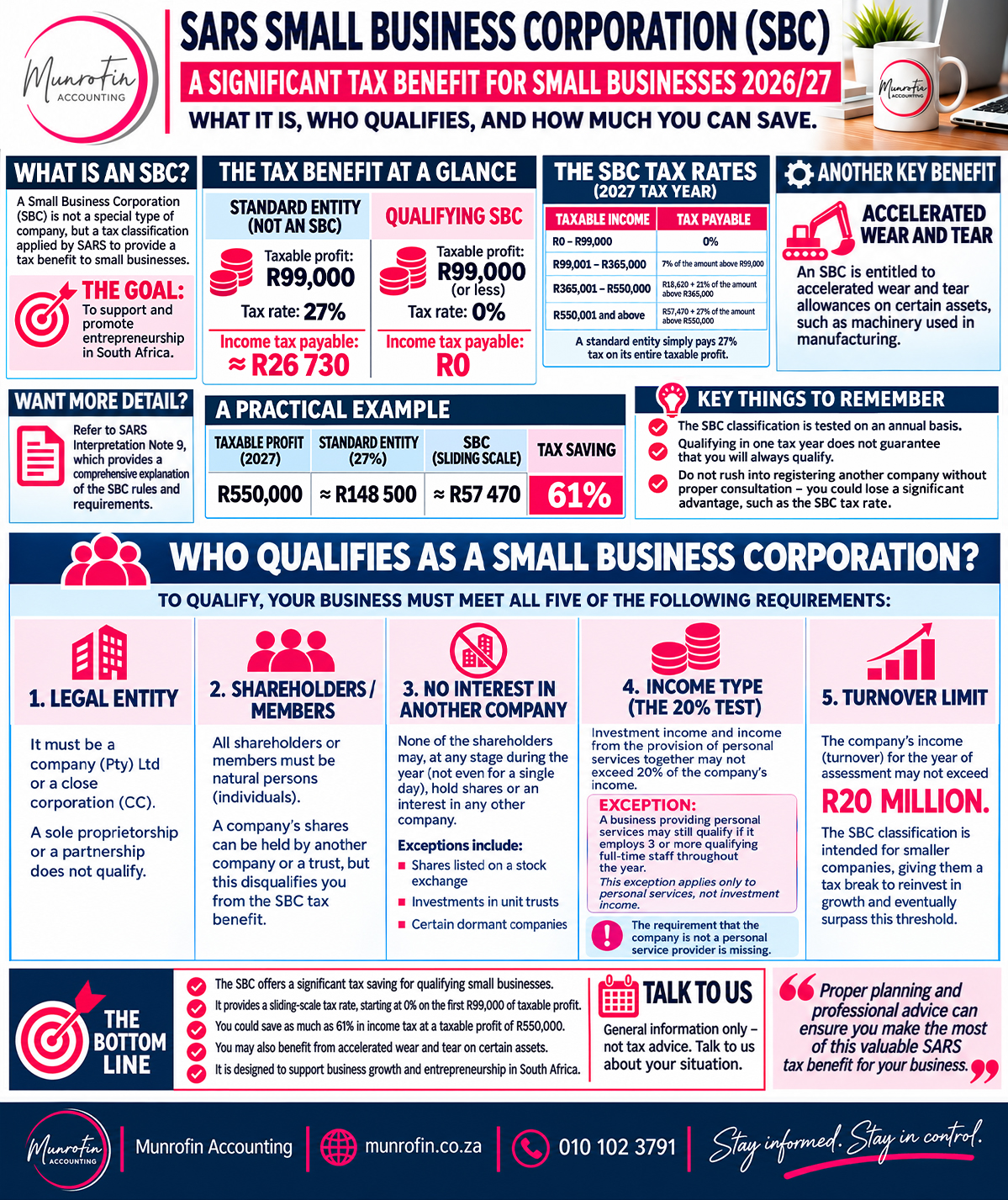
Good day. This is Maryna, and as promised, today I am going to talk to you about the tax benefit that SARS offers to small business enterprises—referred to in English as a “Small Business Corporation.” This is not a special type of company, but rather a classification applied by SARS to provide a tax benefit to small businesses, with the aim of supporting and promoting entrepreneurship.
Listeners are welcome to consult SARS’s Interpretation Note 9, which provides a far more comprehensive explanation than we could possibly cover in these few minutes on the radio. In this discussion, I hope to touch upon the more general guidelines.
To pique your interest—and please note that I will be using round figures—consider this: if the taxable profit for the 2027 tax year is R99,000, a standard entity would pay tax at a rate of 27% (approximately R26,000), whereas a qualifying small business enterprise pays no tax on a taxable profit of R99,000 or less.
Taxation for a small business enterprise operates on a sliding scale: it starts at 0% for the first R99,000, then increases to 7%, 21%, and finally 27% for taxable profits exceeding R550,000 (for the 2027 tax year). In contrast, a standard entity simply pays 27% tax on its entire taxable profit.
To put this into practical terms: a small business enterprise with a taxable profit of R550,000 would pay only about R57,000 in income tax, while a non-qualifying entity would pay approximately R148,000. This represents a tax saving of 61%.
Furthermore, a small business enterprise is entitled to accelerated depreciation allowances on certain assets, such as machinery used in manufacturing—yet another reason why it is worth knowing whether you qualify.
Right, I hope I have your attention now. So, who qualifies as a small business enterprise?
Firstly, it must be a legal entity in the form of a company or a close corporation; a sole proprietorship or a partnership does not qualify.
Secondly, all shareholders or members must be natural persons—not another company or a trust. Don’t get confused here: while a company’s shares can be held by another company or a trust, doing so disqualifies it from this special tax benefit. The rationale is that a company forming part of a group is no longer truly a small business enterprise.
Thirdly—and this point is often overlooked—none of the shareholders may, at any stage during the year (not even for a single day), hold shares or an interest in any other company. There are, however, exceptions—such as shares listed on a stock exchange, investments in unit trusts, and certain dormant companies.
Fourthly, we look at the type of income, and this is very important. If your investment income and income derived from the provision of personal services together account for more than 20% of your business’s income, you do not qualify. Investment income includes dividends, interest, royalties, annuities, and rental income from property.
Personal services refer to fields such as accounting, actuarial science, architecture, auctioneering, auditing, broadcasting, consulting, education and training, engineering, financial brokerage, healthcare, journalism, law, management, real estate agency, information technology, research, sports, translation, valuation, and veterinary science, to name but a few.
There is, however, an exception: if your business provides these personal services but employs three or more full-time staff members throughout the year who perform the services themselves—and who are neither shareholders, family members, nor otherwise connected persons to the shareholders—then your company may still qualify. The rationale here is that you have a team of staff members delivering the service, rather than just you, as the director of your company. Please note: this exception applies only to personal services and not to investment income.
The fifth requirement is that the company’s income—or turnover—for the year of assessment may not exceed R20 million. Remember, the small business classification is intended for smaller companies, offering them a bit of a tax break from SARS, with the hope that they will reinvest these funds into growth and eventually surpass this R20 million turnover threshold.
To summarize, there are five requirements:
- It must be a company or a close corporation.
- The shareholders or members may only be natural persons (individuals).
- The shareholders may not hold shares in any other company, except where permitted by law.
- No more than 20% of the income may be derived from a combination of investment income and personal services, unless the company employs three or more qualifying full-time staff members who provide those personal services.
- The turnover for the year may not exceed R20 million.
This test is applied on an annual basis. In other words, qualifying for the 2027 tax year does not guarantee that you will always qualify—it must be assessed every year.
This represents a significant tax benefit, and I would like to refer listeners to last week’s discussion regarding the registration of companies. Please do not rush into registering another company without proper consultation, as you could lose a significant advantage—such as the small business tax relief.
Listeners are very welcome to schedule an appointment with us to discuss your unique situation further.
Have a blessed and prosperous week ahead!
Need assistance with your tax or accounting matters?
Contact MunroFin for professional tax, accounting and financial services.