Intellectual Disability Can Qualify for Tax Relief
Intellektuele gestremdheid kan kwalifiseer vir belastingverligting
Last reviewed: 22/07/2026
Luister na die Afrikaanse Radio Uitsending
English Transcript of Radio Broadcast
Good day, it’s Maryna here.
Our topic for today is medical disability for tax purposes. I would like to say at the outset that this is not an exhaustive discussion of the topic. My aim is simply to make you aware of when it may apply to you. You can then discuss the details with your tax practitioner.
For tax purposes, SARS does not consider medical disability to be the same as occupational disability. For example, I have a client who worked for the mine and his knees deteriorated to the point that the mine declared him medically unfit for his specific occupation. However, his condition did not seriously affect his functioning of daily activities. So, although he was declared occupationally unfit, he is not medically unfit for tax purposes.
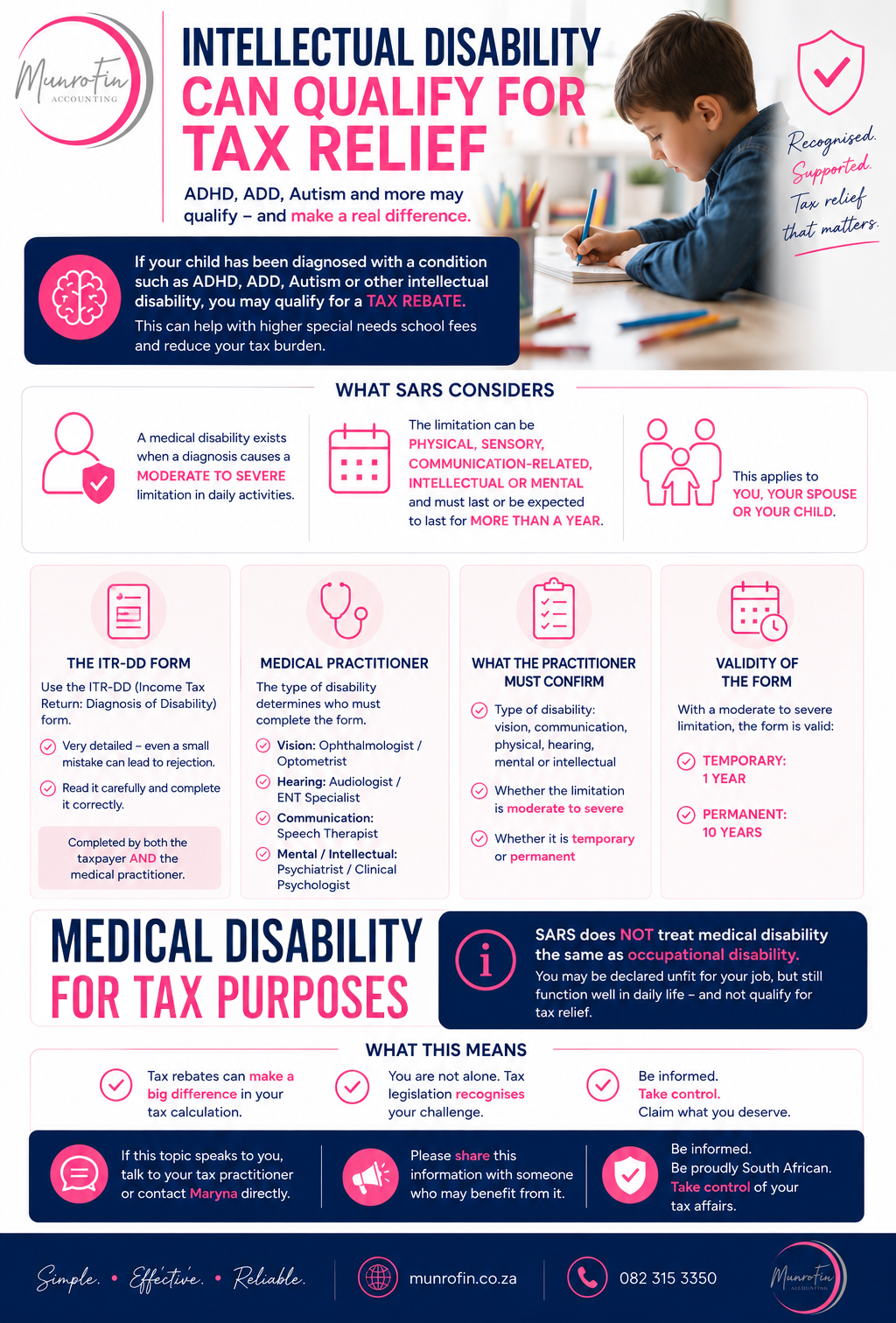
According to SARS, you, your spouse, or child will be medically disabled if the diagnosis places a moderate to severe limitation on functioning or carrying out daily activities. This disability can be physical, sensory, communication-related, intellectual or mental in nature and lasts or is expected to last for more than a year.
The form to be completed is the ITR-DD form, which stands for Income Tax Return: Diagnosis of Disability. ITR-DD. This is a very detailed form to complete. Even a small mistake or a box to be skipped can cause SARS to reject it. So read it through a few times to make sure it is completed properly.
Also note that the form must not only be completed by the taxpayer, but also by the medical practitioner. The type of disability also determines which medical practitioner must complete the form. For example, an ophthalmologist or optometrist for visual impairment; an audiologist or ear, nose and throat specialist for hearing loss; a speech therapist for communication problems; and a psychiatrist or clinical psychologist for certain intellectual or mental disabilities.
The medical practitioner must also indicate what type of disability it is. In other words, is it vision, communication, physical, hearing, mental or intellectual? The practitioner must also indicate whether the disability is moderate to severe, and whether it is temporary or permanent.
A disability with a moderate to severe limitation means that it significantly limits a person’s ability to function or to perform one or more basic daily activities despite therapy, medication and the use of assistive devices. If the disability is temporary, the form is valid for one year. If it is permanent, it is valid for ten years.
I would like to dwell on the intellectual disability, which sounds very serious and is perhaps so easily missed. This classification of disability for tax purposes includes conditions such as ADHD, ADD and autism, to name just a few examples. I might explain it better to say that if your child has been diagnosed with a condition that means that your child may not be able to function in a mainstream school, but rather in a special needs school, then it is possible that you as the financial caregiver of such a child may qualify for the tax rebate.
This really makes a difference to your tax calculation and even the higher school fees of the special needs school, which are more than your local mainstream school costs, are taken into account for your tax rebate. I have already mentioned in previous talks that our tax legislation is reasonable and fair, although it is in our human nature to always think that we pay too much tax.
But here is an example that our South African tax legislation recognizes the special challenges of disability and gives rebates. So, for the disabled listener, or the parent of a disabled child, or the spouse of a disabled person. I hope this talk makes you feel, if only for a moment, less alone and perhaps bring some relief in the knowledge that even the cold and sometimes complicated language of tax legislation recognizes you and supports your challenges by providing tax relief.
If this topic has awakened something in you today, please talk to your tax practitioner or contact me directly. And please share this information with someone who may also benefit from it. Be informed, be proudly South African and take control of your tax affairs. Until next week then, have a nice day.
Need assistance with your tax or accounting matters?
Contact MunroFin for professional tax, accounting and financial services.