VAT in South Africa: A Practical Guide for Business Owners
BTW in Suid-Afrika: Verstaan Dit, Bestuur Dit en Laat Jou Besigheid Groei
Last reviewed: 14/10/2026
Luister na die Afrikaanse Radio Uitsending
English Transcript of Radio Broadcast
GOOD DAY
This is Maryna, and today I’d like to give a brief introduction to VAT—Value-Added Tax.
I always get excited when someone approaches me because they want to start a business. Entrepreneurship is important and contributes to a healthy economy and South Africa now needs more enterpreneurs.
However, I find that new entrepreneurs often confuse VAT with income tax.
Since the aim of these talks is to better inform the general public, today I will be speaking specifically to listeners who may not yet have much experience with tax matters.
Companies are usually automatically registered for income tax with SARS during the registration process, and nowadays employers must also register any salaried staff who pays monthly PAYE, for income tax as well; however, VAT works differently—it requires a specific application, and we accountants sometimes need a great deal of patience to get VAT registrations approved by SARS!
Individuals running a business, as well as companies, can register for VAT if they meet the requirements.
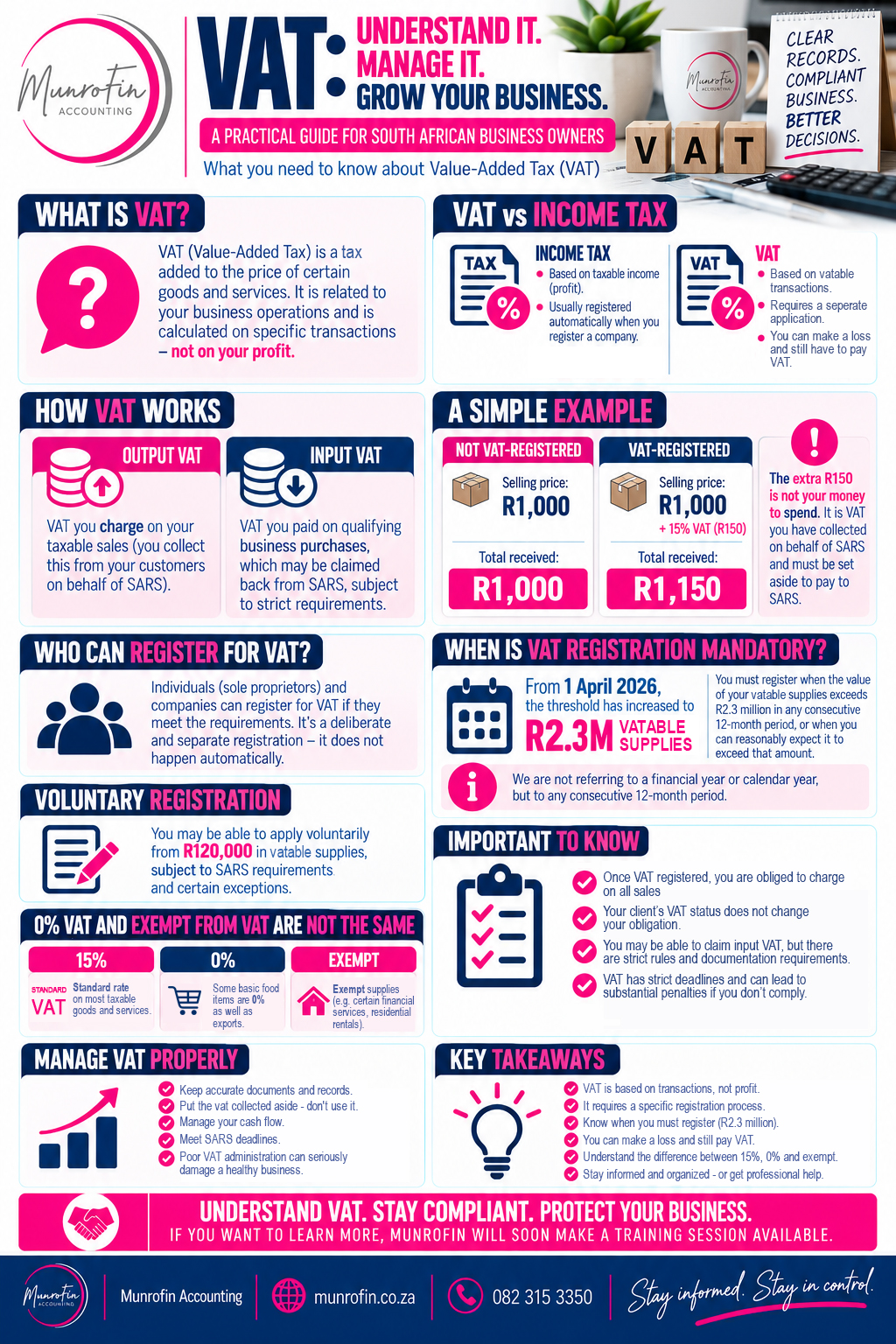
If you are registered for VAT, you essentially act as an agent for SARS, because you collect VAT from your clients on behalf of SARS and must pay it to SARS on a regular basis. The VAT you charge on your taxable sales is known as output VAT. The VAT that you paid on qualifying business purchases, can, subject to strict requirements, be claimed back, from SARS as input VAT.
While income tax is calculated on taxable income, VAT is calculated on specific transactions, regardless of whether or not you make a profit. It is therefore possible for your business to incur losses yet still be required to pay VAT.
If you are registered for VAT, you do not have a choice regarding whether or not to charge VAT on your taxable sales; this is prescribed by law. Whether or not your client is registered for VAT does not alter this obligation. There are, of course, certain exceptions, such as sales taxed at 0% or those that are exempt from VAT. It sounds like the same thing, because both have no VAT on, but technically there is a big difference.
You may have heard from VAT-registered business owners about the difficulty of paying VAT to SARS. This problem can sometimes arise because VAT is not properly managed within the business’s cash flow and administration.
Let me explain.
Suppose you are not registered for VAT and your product price is R1,000. You receive R1,000 in your bank account.
But now, suppose you are registered for VAT and you charge 15% VAT on top of your price. Your invoice total is now R1,150, and you receive R1,150 in your bank account.
In other words, you are now receiving more money than before. The R1,000 is your selling price, but the extra R150 is VAT that you have collected on behalf of SARS. Therefore, you cannot simply spend it on other business expenses; you must set it aside to pay the VAT to SARS.
As I mentioned earlier, you may be able to claim back input VAT on qualifying purchases, but there are strict requirements you must meet.
VAT is therefore a tax for which you must register deliberately and separately. It requires proper administration, involves strict deadlines, and can lead to substantial penalties if you fail to meet your obligations.
Poor VAT administration can severely damage a healthy business. VAT is certainly not for the faint-hearted!
However, if you understand and manage it properly, this “monster” transforms into a routine part of your standard business administration. You will, however, most likely need to adjust your mindset and administrative processes accordingly.
When is VAT registration mandatory?
From 1 April 2026, the threshold for mandatory VAT registration has been raised from R1 million to R2.3 million. You must register when the value of your taxable supplies exceeds R2.3 million in any consecutive 12-month period, or when you can reasonably expect it to exceed that amount.
Note: We are not referring to a financial year or calendar year, but to any consecutive 12-month period.
If you are not yet required to register, you may be able to apply voluntarily. The standard minimum threshold for this is currently R120,000 in taxable supplies, subject to SARS requirements and certain exceptions. VAT is a topic that cannot be fully covered in a single talk. Munrofin will soon make a training session available for those who wish to gain more in-depth knowledge.
The most important thing to remember is that VAT is based on taxable transactions, not on your profit. It is also important to know when you are required to register. If your taxable turnover is approaching the R2.3 million threshold, please take steps as soon as possible to meet your registration obligations.
Stay informed and organized; if this is not one of your strengths, find someone to fill that gap so you can focus on what you do best.
Happy doing business!
Need assistance with your tax or accounting matters?
Contact MunroFin for professional tax, accounting and financial services.